Shopify / Automotive stores
Shopify year, make & model filtering
A vehicle finder needs reliable compatibility data, clear choices and useful results. Here is how to plan the data, choose an approach and check the finished experience.
Start with the fitment data.
List which products fit which vehicles before choosing a dropdown design. Decide whether make, model and year are enough, or whether trim, engine, body style or factory equipment changes compatibility.
A vehicle finder can route to a collection, filter a catalog or open a specific product. Agree which result the customer should reach, and who maintains that mapping when the catalog changes.
Keep each vehicle and year match together.
One part may fit several vehicles across different year ranges. Storing all model names in one list and all years in another can lose the relationship between them. A match needs to belong to the same vehicle record.
| SKU | Vehicle | Supported years |
|---|---|---|
| DEMO-01 | Example coupe | 2016-2018 |
| DEMO-01 | Example sedan | 2020-2022 |
| DEMO-02 | Example coupe | 2020-2022 |
A shopper choosing the example coupe in 2021 should see DEMO-02. DEMO-01 should not match just because its separate lists contain both “coupe” and “2021.”
Record the product or variant identifier, vehicle, year range, exceptions and source of the data. Normalize names such as abbreviations and generation labels. Shopify metaobjects can hold structured information, but storing it does not implement the matching rules for you.
CARBON.DEPT / Vehicle discovery
Enable the next choice. Clear the old one.
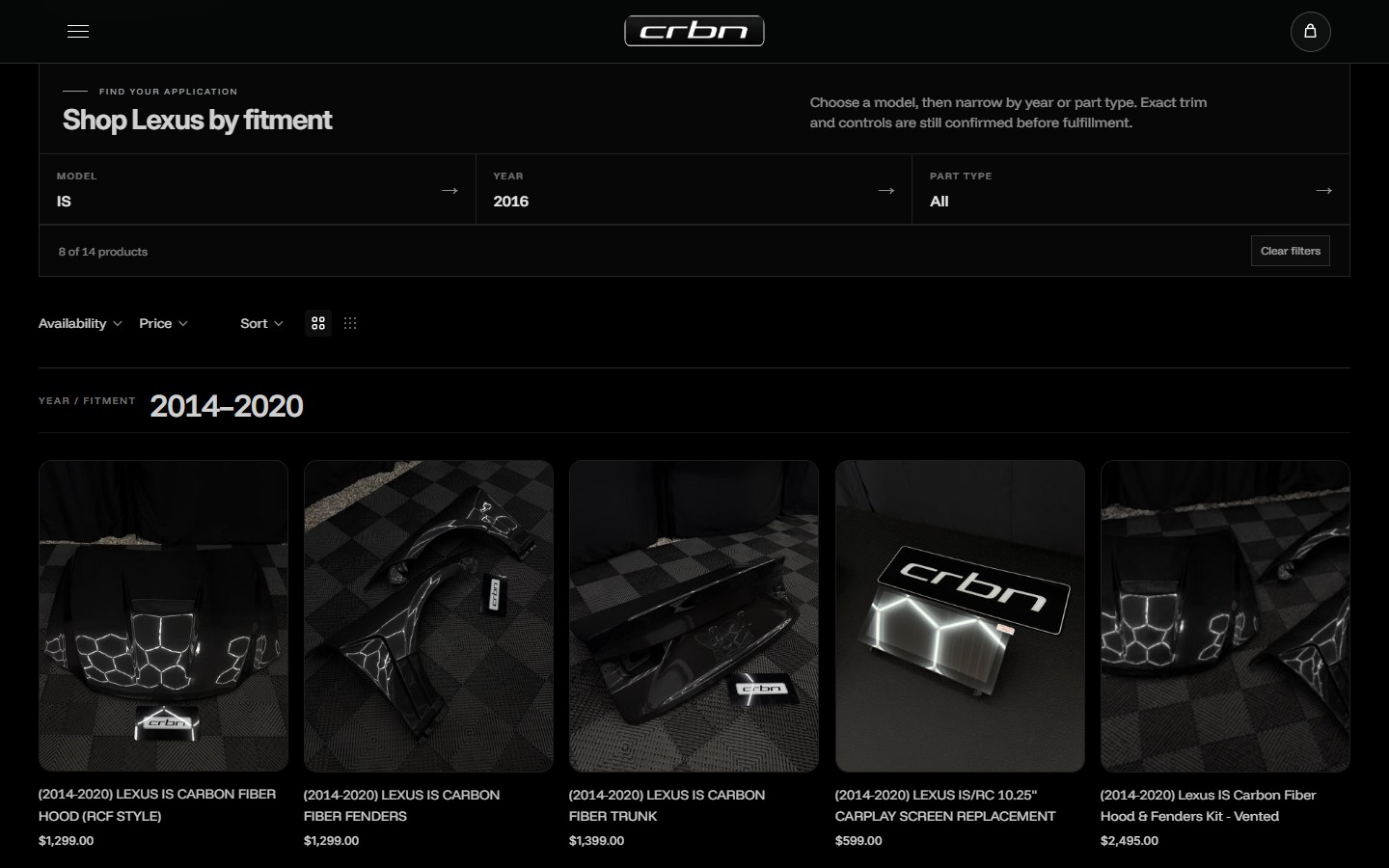
In our CRBN finder, choosing a make enables the relevant models. Changing that make clears the previous model and year. A selected application leads to a product or collection; unusual builds can use a fitment-confirmation route.
The Jalisco project also organizes vehicle browsing alongside detailed wheel choices. Finding an application and configuring the product are separate steps.
See the CRBN implementation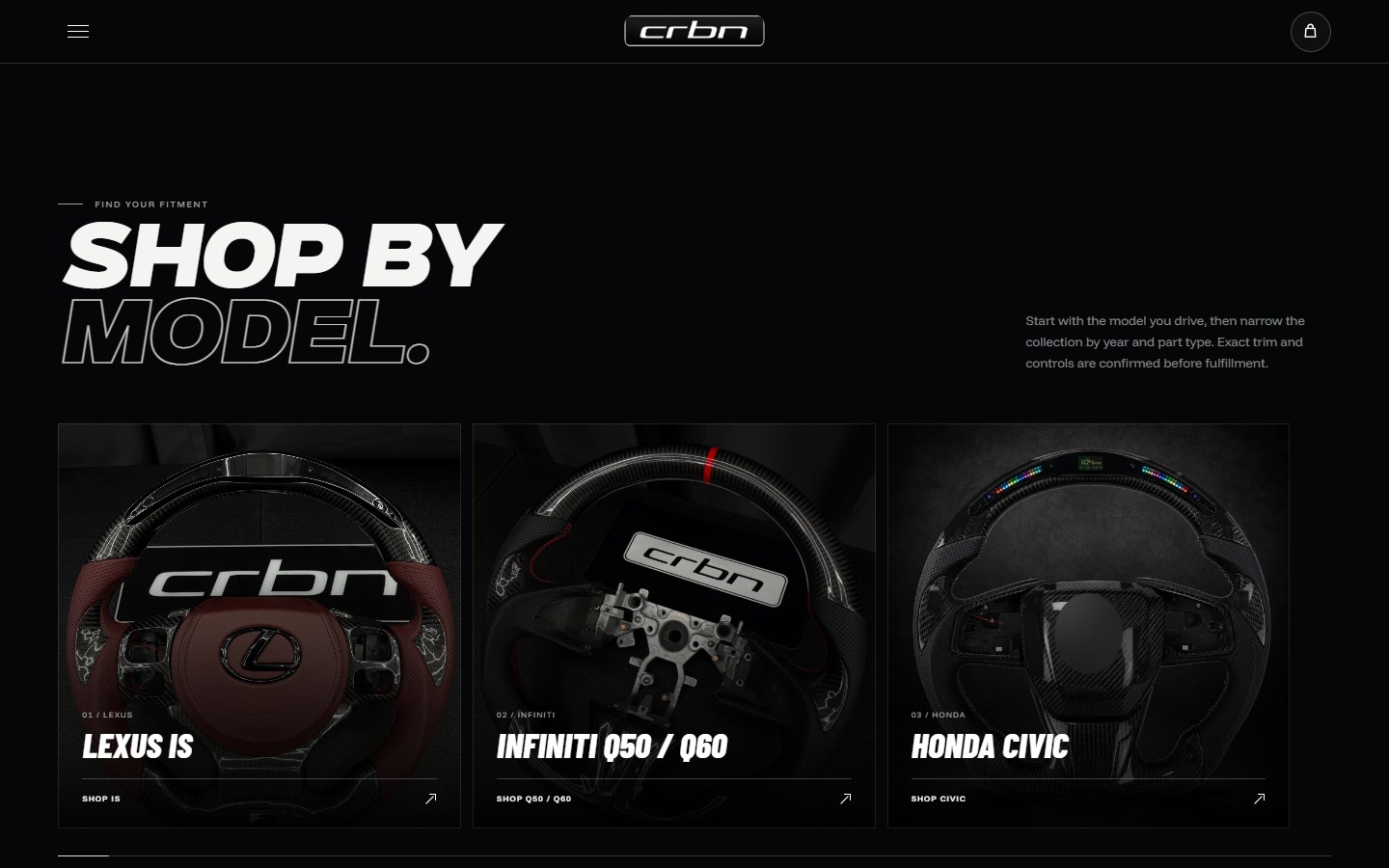
Choose the approach your catalog needs.
| Approach | Consider it when | Check before committing |
|---|---|---|
| Search & Discovery | Your requirement fits collection or search-result filters. | Theme support, data structure and the behavior of combined selections. |
| A fitment app | You need a packaged vehicle selector and supported data import. | Your actual CSV, year ranges, exceptions, theme placement and ongoing updates. |
| Custom development | A tested requirement remains outside the existing tools. | The matching rules, data maintenance, result routing and support scope. |
Shopify supports custom filters using product options, metafields and metaobjects in compatible storefronts. Check its current filter documentation against your catalog. Generic filters and a guided vehicle finder are requirements to compare, not interchangeable labels.
For an app example, EasySearch advertises year/make/model filtering and CSV import. Test a sample of your data before buying or commissioning anything. We have not installed or benchmarked that app for this guide.
Make the result useful, including an empty one.
- Show the selected vehicle above the results and provide a clear reset.
- Keep a product's compatibility notes visible when the customer opens it.
- Distinguish a confirmed catalog match, a universal accessory and a custom-fitment request.
- Explain when no matching product is found, with a route to contact the store.
- Keep availability separate: a compatible product can still be out of stock.
A finder organizes discovery. It does not establish physical compatibility beyond the supplied data or replace the merchant's confirmation process.
Test the combinations that can go wrong.
Use expected results supplied by the catalog owner. A selector that returns products is not enough; it must return the intended products and exclude the wrong ones.
- Known match: choose a supported vehicle and verify the exact products returned.
- Wrong pairing: test a year supported by a different model and confirm it does not leak into the result.
- Changed selection: change the make or model and verify that stale choices reset.
- Exception: check a trim, factory-equipment restriction or universal product.
- Phone and return path: complete the selection on a phone, open a product and check the back-navigation behavior.
Agree who corrects fitment records, imports new products and checks the finder after theme or app changes. Our product-options guide covers the separate decision about custom configuration after discovery.
Before you start
Common questions
Can I use Shopify tags for fitment?
Tags can hold labels, but the data still needs to preserve which vehicle and year range belong together. Test products that fit more than one vehicle. A tag list by itself does not prove a correct compatibility match.
Does Shopify include year, make and model search?
Shopify supports storefront filters through Search & Discovery. A guided vehicle selector also needs suitable fitment records, matching logic and theme integration. Compare native filters, a dedicated app and scoped custom work against that complete requirement.
Should universal products appear in vehicle results?
Decide that with the merchant. If universal items are included, identify them clearly instead of presenting them as a confirmed vehicle-specific match. Include this behavior in the acceptance checks.
Plan the finder around your catalog.
Share your store URL, a sample of your fitment records and the result shoppers should reach.
Sources and scope
Platform documentation checked October 17, 2026. The data example uses invented products. CRBN and Jalisco illustrate our own storefront work.
- Shopify: Search & Discovery filters
- Shopify: structured information with metaobjects
- EasySearch: vendor-described fitment and import features
Related: Shopify design and development.